Vedha Studios R&D | Computational research in astrophysical simulations
High-performance simulations of gravitational dynamics and volumetric astrophysical phenomena
This research project investigates gravitational interactions and orbital dynamics using advanced simulation and visualization techniques in Houdini. While traditional N-body simulations capture point-mass interactions for planetary and stellar orbits, our work extends this approach by developing volumetric gravity fields that manipulate mass density, enabling the study of emergent phenomena such as star formation, galactic evolution, and the assembly of planetary systems.
Existing astrophysical simulators illustrate certain aspects of celestial mechanics but have limitations:
Our project addresses these gaps by combining:
By leveraging Houdini’s procedural framework and the high-performance VEX language, we integrate point-based and volumetric simulations seamlessly, offering unprecedented control over both physical accuracy and visual representation. This approach provides a versatile platform for astrophysical research, educational demonstrations, and visually compelling presentations of complex gravitational phenomena.
Large-scale gravitational simulations require robust computational frameworks that can efficiently handle billions of interacting particles. Rather than building custom solvers from scratch, this project leverages established 3D simulation software to accelerate development while ensuring accuracy.
VEX allows efficient computation for N-body and volumetric simulations.
Houdini supports hybrid workflows, combining point-based and volumetric approaches, making it ideal for large-scale astrophysical simulations and research-driven experiments.
In this project, Houdini serves as a computational laboratory, enabling researchers to implement accurate numerical models while leveraging procedural workflows for efficient simulation of large-scale gravitational systems.
The core motivation for this project was to simulate gravity and orbital dynamics and to render astrophysical phenomena such as black holes with realistic light bending. While both Maya and Houdini provide extensibility, their computational and rendering models differ significantly:
Python or MEL.
However, when simulating thousands of bodies, interpreted scripting becomes prohibitively slow.
Writing a C++ plugin would improve performance, but requires recompiling for each test,
which slows iteration during research.
VEX, which is compiled and optimized like C++,
allowing very fast point-wise calculations for N-body gravity simulations.
In addition, VEX doubles as a shading language, enabling the implementation of custom
light-bending effects, lensing distortions, and event horizon shaders needed for black hole visualization.
Its volume-based simulation capabilities allow efficient computation of billions of interacting points, essential for modeling star and galaxy formation.
In summary: Houdini was chosen not only for its computational efficiency in orbital dynamics, but also for its ability to implement volumetric simulations and custom shaders for physically accurate and cinematic visualization of astrophysical phenomena.
We begin with a simplified Newtonian gravity simulation in Houdini to get started. Points represent celestial bodies, and forces are computed based on their mass and separation.
Key Features:
Implementation: Houdini VEX code loops over all points and calculates acceleration vectors based on distances and masses. This approach is fully flexible but scales poorly for extremely large numbers of particles.
For large-scale phenomena like star formation or galactic evolution, we create volumetric gravity fields using OpenVDB volumes.
This approach allows billions of points to be simulated efficiently while retaining high accuracy in regions of interest.
Our R&D introduces a hybrid approach that combines point-based N-body calculations with volumetric gravity fields. This enables high accuracy in dense regions while maintaining efficiency in sparse areas.
This workflow ensures that large-scale simulations remain computationally feasible while producing scientifically meaningful and visually informative results.
While this project focuses on accurate and efficient gravity simulation, the resulting data can be rendered cinematically in our AMR visualization project. By decoupling simulation and cinematic rendering, we maintain scientific rigor while still producing visually compelling results.
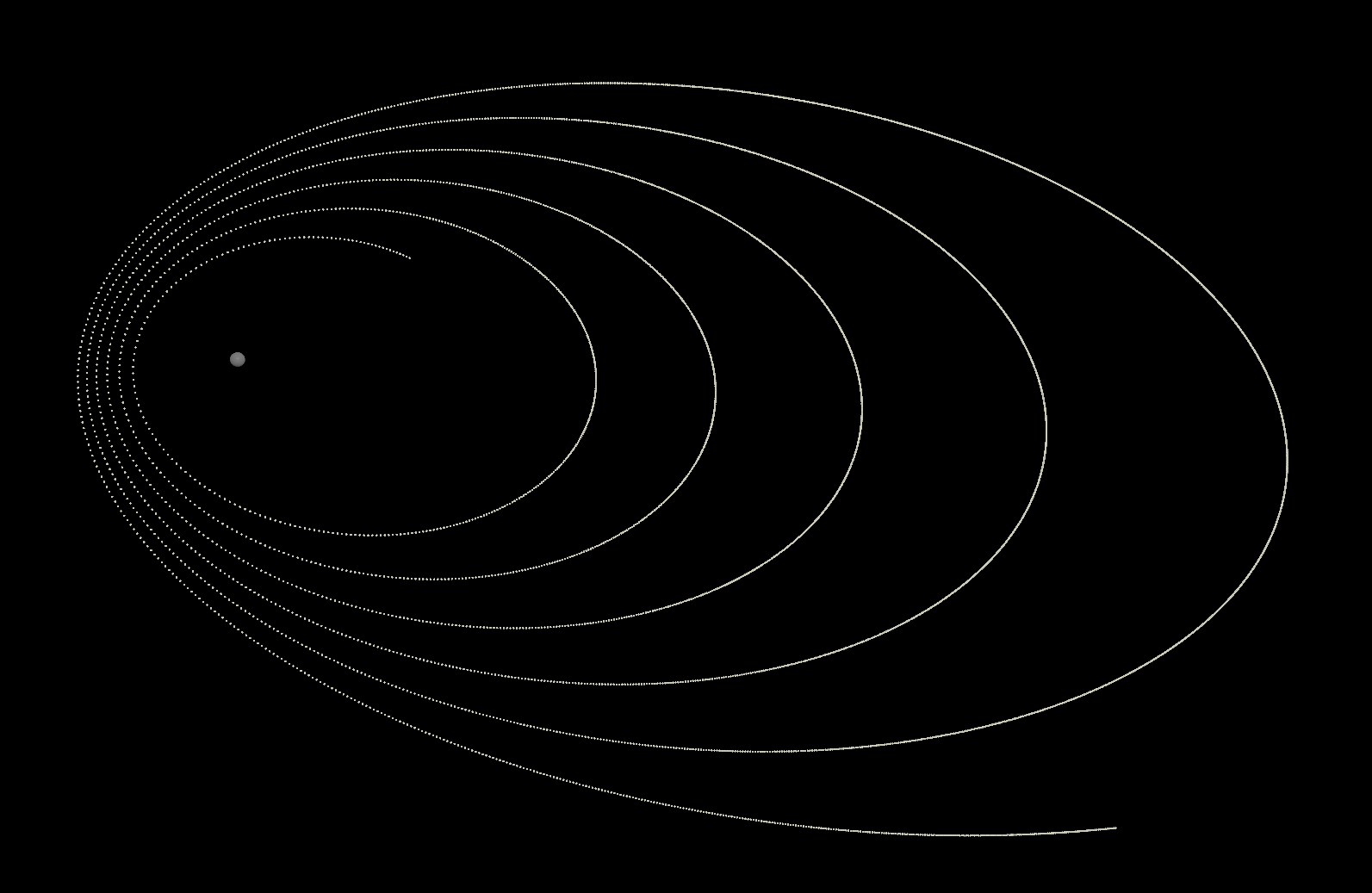
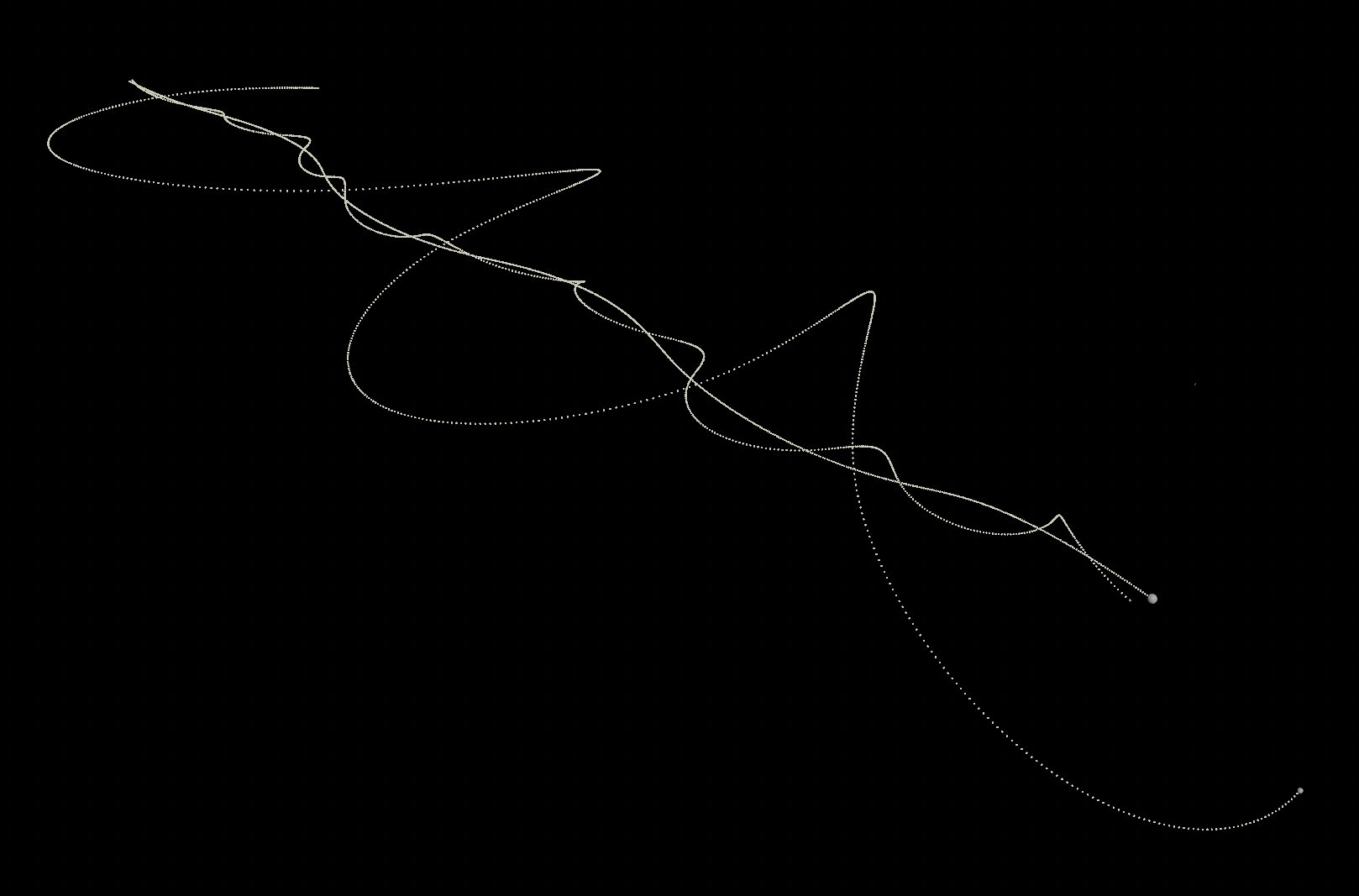
The images and videos below illustrate outputs directly from our gravitational simulation workflows. These represent the raw data produced by point-based, volume-based, and hybrid simulations before cinematic rendering in AMR.
Note: These visualizations are preliminary outputs from the simulation pipeline. Photorealistic rendering, lighting, and cinematic effects are applied in the AMR project.
Our research leverages industry-grade 3D software and scripting tools to efficiently simulate large-scale gravitational systems:
To begin exploring gravitational interactions in Houdini, we provide a simplified Newtonian gravity simulation. This setup computes pairwise forces between points, suitable for small systems or educational purposes.
int npts = npoints(0);
float G = 0.001;
vector g = {0,0,0};
for (int i = 0; i < npts; i++){
if (i == @ptnum) continue;
vector p1 = @P;
vector p2 = point(0, "P", i);
float m1 = @mass;
float m2 = point(0, "mass", i);
vector dir = normalize(p2 - p1);
float r = length(p2 - p1);
float acceleration = G * m1 * m2 / (r*r);
g += dir * acceleration;
}
@force = g;
@v *= 0.99;
Explanation:
G – gravitational constant (adjust for simulation scale)@P – current point’s position@mass – point mass@force.@v *= 0.99; – damping to stabilize motionFor convenience, users can download and use the Houdini Digital Asset (HDA), which encapsulates this code and provides a ready-to-use interface.
For large-scale systems such as star formation or galactic evolution, point-based methods alone are computationally expensive. We introduce a hybrid approach that combines point-based N-body simulations with volumetric gravity fields.
This hybrid simulation allows efficient handling of billions of particles and produces high-quality data for further scientific analysis or cinematic rendering in the AMR project.
Implementation Notes: Houdini’s procedural framework and OpenVDB support are used to generate and advect volumetric fields. Points follow the gradient of the density field each frame, allowing accurate simulation of emergent structures while maintaining computational efficiency.
Artists or researchers more comfortable with Maya can use a simplified Python script that computes Newtonian gravitational forces between selected objects without volumetric fields. This approach is ideal for small-scale simulations or visual experimentation.
import maya.cmds as cmds
import maya.api.OpenMaya as om
def apply_gravity(objs, G=0.001):
positions = [om.MVector(*cmds.xform(o, q=True, ws=True, t=True)) for o in objs]
masses = [cmds.getAttr(o + ".scaleX") for o in objs] # using scale as proxy for mass
forces = [om.MVector(0,0,0) for _ in objs]
for i in range(len(objs)):
for j in range(i+1, len(objs)):
p1, p2 = positions[i], positions[j]
m1, m2 = masses[i], masses[j]
dir_vec = p2 - p1
dist = dir_vec.length()
if dist < 0.001: continue
force_mag = G * (m1 * m2) / (dist * dist)
f = dir_vec.normal() * force_mag
forces[i] += f
forces[j] -= f
for i, obj in enumerate(objs):
cmds.move(forces[i].x, forces[i].y, forces[i].z, obj, r=True)
objs = cmds.ls(sl=True)
apply_gravity(objs)
Tip: This script provides a quick way to simulate gravity in Maya, but for large-scale, hybrid simulations, Houdini is recommended.
Vedha Studios R&D welcomes collaboration with physicists, developers, and visual effects artists to advance the study of gravitational dynamics at scale. This project focuses on efficient and accurate simulation of large N-body systems, volumetric matter accumulation, and hybrid workflows combining both approaches.
Contact us at research@vedhastudios.ca or visit our Research Portal to explore collaboration opportunities.